immaculate love
reflections on omid safi's radical love,, my open marriage with Allah, and musings about the makings of the universe

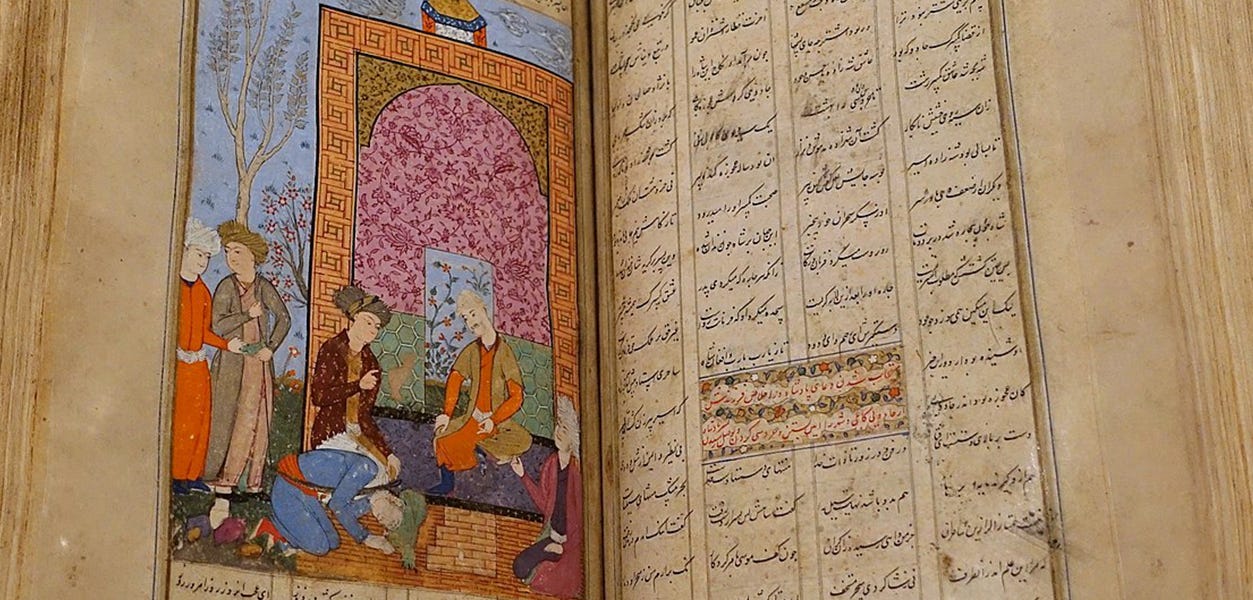
_by_Mowlavi_(Jalal_ad-Din_Rumi),_Iran,_dated_May_26,_1603_AD,_ink,_watercolour,_gold_on_paper_-_Aga_Khan_Museum_-_Toronto,_Canada_-_DSC06700.jpg)
What does it look like to fall in love with God? Not to love God because all your life your parents instructed you to. Not because of wider societal pressures, despite how “tolerant” people claim to be. Definitely not motivated by a fear of eternal damnation. But to love Allah as a friend, a lover, a loved one.
What would it look like to earnestly confide in God? To reach out and build a rapport with the source of your existence?
I thought I always knew the answer. Even when I was young, scrolling through and leaping from one Wikipedia page to another, I was constantly trying to make sense of life, Islam, and the afterlife. I would leave feeling reassured and enlightened by the exploration. That excursion made conversations with God less scary. It never teetered into the territory of delusion or psychosis, although I have been pondering the state of my mental health for quite some time.
Whether the conversation was about my place in life or the state of my loved ones, I might have looked alone when musing about these scenarios, but it never felt like I was alone. Even in moments where I felt Allah was listening, it never happened in the vivid, almost cartoonish manner that performative religious people speak about. It felt as regular as making a mental note, but also felt as relieving as catching up with a friend. Honestly, it is moments like that where I feel the holiest.
I say that to say, perhaps I got the gist of it over the course of my life on here, but I never felt interested in delving deeper. Am I giving myself not enough credit, or possibly far too much? I never knew for sure until I picked up Radical Love: Teachings From The Islamic Mystical Tradition, a collection of poems edited by Omid Safi.
In a little bit over three days, I found myself enraptured by the musings of poets like Rumi, Hafez, Rābiʼa al-ʼAdawiyya al-Qaysiyya, and Abu Sa’id, to name a few. Not only did they write in a similar, flowery language that I tend to write in as well, but their words deeply resonated with me. The legibility of the collection proved to be more about reading to understand. Instead, Radical Love stands as one of the recognizable books in my growing catalogue that does not simply entertain or move me; it affirms me and serves as a sturdy path forward to a future I want to build for myself and a future I want to contribute to with a world united under empathy, intellect, and selflessness.
I think anyone born into organized religion can speak to the combination of fear and self-loathing that festers in the mind. Namely, a fear of being neglected or even abhorred by God due to various characteristics, both innate and learned. However, I have grown to take a more simplistic approach to my belief in the divine, and Omid Safi’s Radical Love felt like the guide I needed to further articulate why I remain in conversation with my Muslim faith without sacrificing my queerness and blackness. In fact, I would not be shocked if this serves as a foundational text of sorts for Islamic Liberation Theology.
Not only does the collection discuss an interpersonal connection with God, but it also explores the manifestations of said love in our realm. Beliefs like justice, romance, and a universal love of humankind are deemed dialects of a divine language that brings one closer to God.
Nonetheless, due to blasphemy and the co-opting of righteousness and virtue by organized religion and their bourgeoisie brethren, I can recognize how a proclamation of Allah as lovely can leave someone feeling jaded, as religion and God’s image have been used as a weapon to denigrate and dehumanize. Furthermore, I too wonder why Allah never intervenes to disrupt slavery, genocide, femicide, to name a few.
Perhaps, Allah is a god that simply creates and lets said creations operate on complete free will. Or maybe there is a demiurge-like figure that sits between us humans and God, who can be reasoned with. Being introduced to the concept of such during my online course on modern world literature has expanded my imagination about the makings and functions of the universe. It has also led some credence to a lingering henotheistic theory I’ve had in mind ever since I started reading Rick Riordan’s novels in middle school. More on that at another time.
I carry these questions and express my curiosity in hopes of finding “the answer,” but I see myself on a bridge, arriving at the conclusion that I feel most comfortable not knowing every single detail there is to know about our living, breathing universe. What emboldens me is the abilities and resources I have access to as a human being. Even when I feel at my most powerless, I recognize the sturdy foundation that has been built for me by my ancestors and the many coalitions of compassion and change that brought Earth one step closer to an Eden we dream of. I look to current efforts and moves towards liberation and justice, an accountability that doesn’t serve as a shield for one’s venom but a tool for healing and growth.
When I read passages like “Joy Inside The Heart” by Rumi and learn about the literal translation of the world “إحسان” (ʾiḥsān), I not only see and believe in Allah as a force of love but I’m also able to tie the lessons I’ve learned from Radical Love to songs like “Deep In The World” by Ravyn Lenae. Contrary to popular belief, balancing an appreciation for the otherworldly while keeping my feet firm in this realm are not diametrically opposed to one another. Moreover, finding the harmony with that is far from the easiest process in the world, but it sure is rewarding.
I really hope you all enjoyed reading this, and I hope to return soon with more wisdom, delusion, and a fun in between of the two. We’ll see!
until next time,
momo <3